
You rank in ChatGPT answers by making your page easy to find, easy to understand, and safe to cite. Start with access: allow the relevant AI crawler, publish one consistent source of truth, answer the question in the first sentence, and support important claims with links to evidence. No tactic guarantees a mention, but this workflow gives an AI system a clear reason to select your page.
Generative engine optimization (GEO) is the work of improving how AI search systems discover, interpret, and cite your content. It sits beside search engine optimization (SEO), not apart from it. The same page still needs a crawlable URL, useful information, clear structure, and a reason for people to trust it.
1. Can ChatGPT crawl your website?
ChatGPT can't cite a page it can't reach. Check your robots.txt, server responses, redirects, and bot controls before changing the copy.
OpenAI documents separate controls for OAI-SearchBot, GPTBot, and ChatGPT-User in its crawler documentation. OAI-SearchBot controls eligibility for ChatGPT search results. GPTBot relates to crawling for model training. Treat those as separate decisions and document the policy your team wants.
Run this check on every page you want AI systems to find:
- Confirm the canonical URL returns HTTP 200.
- Check that robots.txt doesn't block the crawler you intend to allow.
- Remove redirect chains, login walls, and JavaScript-only content from the main answer.
- Make the important text available in the initial HTML, not only after an interaction.
- Check that your sitemap contains the canonical URL.
Access is the first gate. Content quality matters after the crawler can actually read the page.
2. What should be the source of truth for each topic?
Create one canonical page for each product, service, or concept. That page should define the entity once and link to deeper pages when readers need more detail.
Give the page a stable set of facts:
- The exact name and a one-sentence definition
- Who it serves and who it doesn't serve
- Key features, limits, integrations, and requirements
- Current pricing or a link to the official pricing page
- A visible last-updated date
- Links to documentation, research, or first-party proof
AI systems compare signals across pages. Conflicting names, outdated feature lists, and different pricing statements make your site harder to trust. A canonical page won't force a citation, but it gives retrieval systems one clean passage to use.
3. How should you write an introduction for AI answers?
Put the answer in the first sentence. Follow it with the main constraint, then show the evidence and the steps.
Use this pattern:
- Answer the question directly.
- Say who the advice fits and where it stops.
- Explain the process with headings and examples.
- Link each important factual claim to its source.
For example: “You improve your chance of appearing in ChatGPT answers by publishing crawlable, consistent, evidence-backed pages.” That sentence gives a model a complete idea without requiring it to combine several paragraphs.
Plain language helps readers and machines. Explain a specialist term the first time you use it, then use the term consistently.
4. Which page structure helps AI systems extract answers?
Use short, modular sections that answer one question at a time. Google recommends making content accessible to crawlers and organizing pages so search systems can understand their subject in its Search Central documentation.
A useful structure includes:
- Question-shaped H2 and H3 headings
- Two or three sentences that answer each heading immediately
- Bullets for requirements, pros, cons, and checks
- Numbered steps for a process
- Tables when readers need to compare constraints
- An FAQ with complete answers, not one-line fragments
A simple page template
| Section | Job |
|---|---|
| Direct answer | Give the quotable conclusion |
| Definition | Clarify the entity and audience |
| Process | Show what to do next |
| Evidence | Support claims with first-party or research sources |
| Constraints | State what the advice cannot solve |
| FAQ | Cover related questions in plain language |
This format also gives editors a practical review checklist. If a section doesn't answer a real question, remove it or combine it with a stronger section.
5. What proof should an AI-optimized page include?
Add at least one proof artifact that a reader can inspect. Good options include a benchmark with its method, a changelog, a public methodology, a first-party documentation page, or a comparison table with dates and constraints.
A claim such as “our process improves visibility” is weak on its own. A claim tied to a defined measurement window, sample, and source is easier to evaluate. Label your own observations as observations. Don't turn a product opinion into a research finding.
Use authoritative references for general guidance. The Princeton GEO paper is a useful starting point for the research behind generative engine optimization. For technical crawling guidance, use OpenAI's crawler documentation and Google Search Central.
6. How do you make your brand clear to ChatGPT?
Keep your brand name, abbreviation, product names, and descriptions consistent across the site. Entity clarity means helping an AI system distinguish your company from words, products, or companies with similar names.
Use the same facts in your About page, product pages, author profiles, schema markup, and external profiles. Add a canonical link and connect official social profiles where they help confirm the entity.
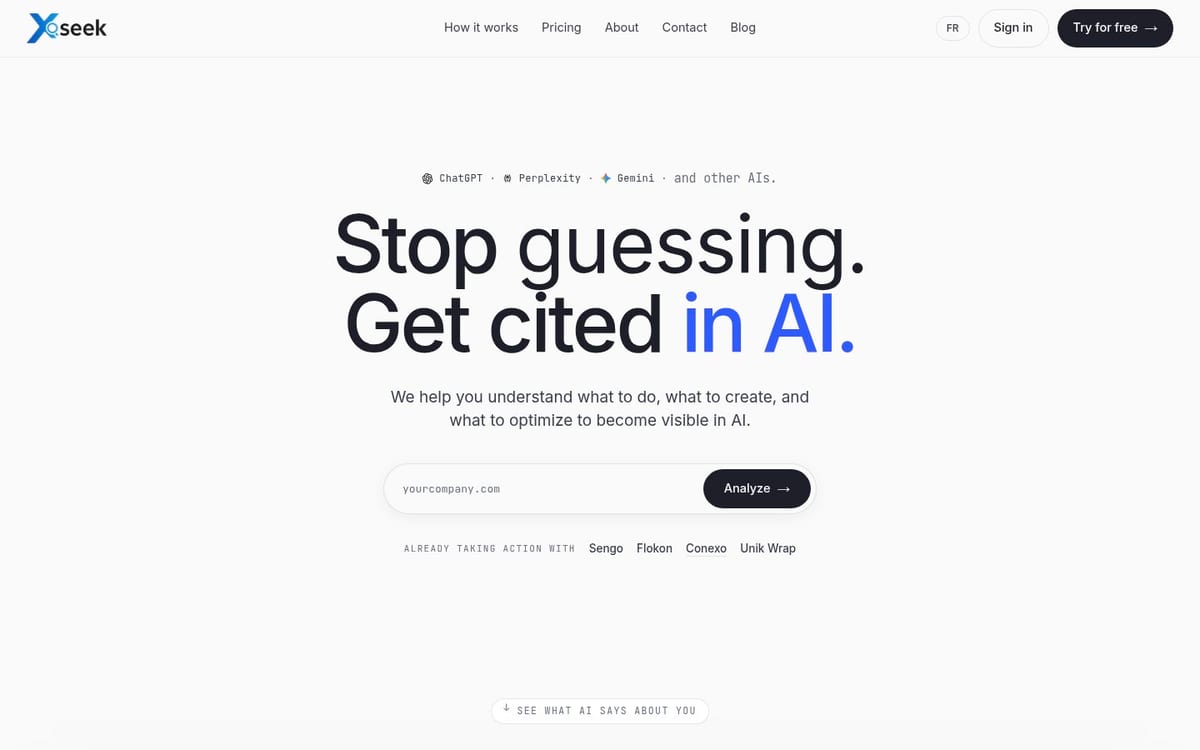
For xSeek, the AI visibility platform tracks how brands appear in AI answers and helps teams turn findings into content and optimization work. Its AI visibility tracking page explains the product in its own words. Check those pages for current capabilities rather than repeating an old feature list.
7. What makes a comparison page useful in AI search?
Specific constraints make comparison content more useful than a list of vague winners. Tell readers which option fits each job and show the facts behind that recommendation.
Include these columns when they apply:
- Best for
- Core capability
- Integrations or platform limits
- API or export access
- Team and agency support
- Pricing status and billing link
- Last verified date
Link every named product to its official website. Don't publish a price unless you checked the current pricing page. If a vendor doesn't publish a price, say “contact the vendor for pricing” and link to the vendor's site.
The best comparison page isn't the one with the strongest superlatives. It's the one that lets a reader rule options in or out quickly.
8. How often should you refresh pages that AI cites?
Refresh a page whenever a fact, product, source, or recommendation changes. Put the update date near the content and record the material changes in a short changelog.
Review these items on each refresh:
- Product names and feature limits
- Pricing and billing terms
- Links and citations
- Screenshots and examples
- Robots.txt and indexability
- FAQ answers and structured data
Don't change the date just to make an old page look new. The timestamp should tell readers when the claims were last checked.
9. How should you track ChatGPT ranking work?
Track prompts, mentions, citations, and the actions you took. A keyword list alone can't tell you whether an AI answer names your brand, cites your page, or prefers a competitor.
Build a prompt backlog with three groups:
- Decision prompts: “What is the best [category] for [constraint]?”
- Comparison prompts: “[your product] vs [competitor]”
- Troubleshooting prompts: “How do I fix [specific problem]?”
Map each prompt to one page. Record the answer, cited sources, competitors mentioned, and the next content change. Tools such as xSeek's AI visibility tracking can help you monitor brand mentions and citations across AI search engines. Use the data to choose an action, not to build another report nobody opens.
A one-week GEO sprint
You can put this workflow into motion in five working days:
- Choose ten buyer prompts and group them by intent.
- Test crawl access and indexability for the pages you want cited.
- Assign one source-of-truth page to each topic.
- Rewrite each introduction as a direct answer.
- Add evidence, constraints, internal links, and an FAQ.
- Publish a changelog and record the verification date.
- Check the prompts again and log what changed.
Add relevant internal links such as how to improve AI search visibility, the AEO tools comparison, and how to track AI crawler visits. Each link should help the reader take the next step.
FAQ
How do I write articles that get cited by large language models?
Write a direct answer first, use clear question-based headings, and support factual claims with links to evidence. Keep one source of truth for each topic and update the page when its facts change.
What tools can help me write content that gets cited by ChatGPT, Claude, and Perplexity?
Use an AI visibility platform to track prompts, mentions, cited URLs, and competitors, then use an editor or writing tool to improve the page. The tool matters less than the loop: observe an answer, make a specific content change, and measure the same prompt again.
What are the best AI writing tools for ChatGPT and AI search engines?
The best tool depends on whether you need drafting, source checking, content optimization, or visibility measurement. Choose one that helps you produce evidence-backed pages and connect the work to real prompts instead of judging success by generated text alone.
Does SEO still matter for ChatGPT answers?
Yes. Crawl access, canonical URLs, useful page content, internal links, and clear page structure still support discovery. GEO adds a focus on answer extraction, citations, entity clarity, and prompt-level measurement.
Should I block GPTBot or allow it?
That is a publishing and data-use decision for your organization. OpenAI says OAI-SearchBot controls inclusion in ChatGPT search results while GPTBot relates to training crawls, so review each directive separately in the official documentation.
How do I improve ChatGPT answer quality about my brand?
Publish accurate first-party information and repeat the same names, definitions, limits, and links across your site. Fix contradictions, add a visible update date, and monitor the prompts where ChatGPT gets your brand wrong.
Sources & References
- OpenAI crawler documentation: bot controls and use cases
- Google Search Central SEO guide: crawlable, understandable pages
- Princeton GEO research: generative engine optimization methods
- xSeek AI visibility tracking: visibility measurement product
- xSeek ranking factors guide: related internal guidance